How to Check birthday countdown: Practical Notes from Real-Life Math
The best small calculators feel almost boring: clear fields, visible units, and an answer that can be copied with its assumptions. That calm matters for a family planning a birthday trip, especially with a flight across two time zones approaching and a leap-day birthday and a midnight arrival on the page. A birthday countdown should reduce clerical effort without hiding the arithmetic. The result gets compared with a quick expectation. If the two answers disagree wildly, the input list gets checked before anything else. Two independent methods are useful for a decision with real cost. I may use a birthday countdown, then repeat the formula on paper, in a spreadsheet, or by reversing the operation. A second method is most useful when it fails loudly. Copying the same wrong value into two websites does not count as verification, so the source numbers get checked as well. 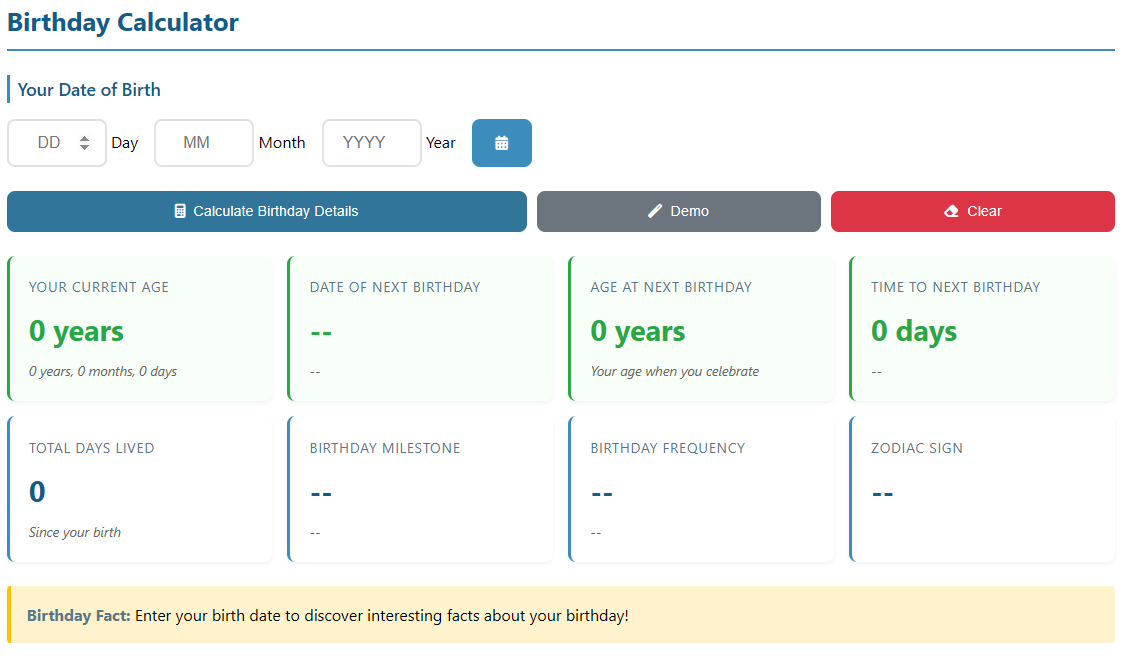 A birthday countdown sounds simple until time zones and today's partial day enter the picture. Decide whether the question means calendar days, full 24-hour periods, or a live clock to a specific time. For invitations, calendar days are usually easier to explain. If the birthday is today, a useful tool should say so instead of jumping straight to 365. I also check whether the calculator rolls to the next birthday automatically and whether February 29 receives a visible rule. Date tools need an explicit rule for the start and end points. An age calculator may count full calendar years, while a birthday countdown usually counts days until the next occurrence. Enter 03/04/2012 without a locale label and two people may read different dates. The form should echo the date in an unambiguous format. Leap-day birthdays also need a stated convention for non-leap years. The calculator can show the arithmetic, but the user still chooses which date rule fits the school, employer, or family plan. Units stay attached from the first line to the last. Hours do not get added to dollars, centimeters do not quietly become inches, and a monthly rate does not enter an annual field unchanged. The input list includes both value and unit. In a birthday countdown, dropdowns help, but the result should repeat the chosen units. That echo catches the moment a default setting remains on the wrong option. An age result should separate completed years from the extra months and days. Someone born late in the evening has not gained another legal year because a decimal display says 17.99. For an age calculation, use the exact birth date and the date being tested, then read the full-year result first. An age without a reference date becomes stale immediately. Eligibility rules may use a cutoff date that differs from today, so calculate against the date named on the form rather than the day the form happens to be filled out. https://calc.you saved result needs a date, the inputs, and one line naming the purpose. Screenshots often crop out units or the earlier steps. The working should remain readable without the original browser tab. For a family planning a birthday trip, I would record a flight across two time zones and add a note about a leap-day birthday and a midnight arrival. Both can change the interpretation. The note can stay brief; its job is to make the number reproducible, not to document every click. Sensitive details do not always belong in a web form. Birth dates, work schedules, household habits, and financial targets can reveal more than the arithmetic requires. A harmless sample can confirm how the tool behaves. For many personal calculators, the browser only needs the numbers, not a name, email address, employer, or account login. If a result must be shared, remove identifying details and keep the assumptions that another person needs to verify the math. Personal figures change, so I add a review date to recurring calculations. A savings contribution may change after rent rises; a study schedule may shrink during exam week; a subscription may add a seat. A dated note makes later changes easier to explain. With a birthday countdown, I keep the original inputs, the updated inputs, and one sentence about why the change was made. That is enough history to see whether the plan drifted or the situation genuinely changed. The result should end in an action. It might set a weekly transfer, remove an unused plan, reserve another study session, or change the number of paint cans on the list. The next action keeps the answer tied to the original question. For a family planning a birthday trip, the action must fit a flight across two time zones and account for a leap-day birthday and a midnight arrival. Otherwise the tidy answer stays detached from the situation that produced it. A personal estimate should include a comfortable range when the inputs are uncertain. Study time, discretionary screen use, and freelance hours rarely land on the same figure every week. A range is more candid than one polished forecast. Change one uncertain field in the current calculator and watch the result move. If a small change breaks the plan, the next step is a buffer or a different deadline, not extra decimal places. A useful calculation leaves a trail another person can follow. I keep the question, inputs, units, result, and one sentence about the decision. The note shows where a future correction belongs. The calculator has finished its part when a family planning a birthday trip can move toward a flight across two time zones with a leap-day birthday and a midnight arrival accounted for.